
GAIN Public Health is a platform dedicated to sharing practical insights, evidence-based knowledge, and real-world experiences in public health, training, and capacity building. Our blog serves as a learning space for students, professionals, institutions, and communities seeking to understand evolving health challenges and solutions—from disease prevention and health systems strengthening to innovation, equity, and community resilience. Through expert perspectives, field learnings, and accessible resources, the GAIN Public Health blog aims to bridge the gap between knowledge and action, supporting informed decision-making and sustainable improvements in health and development outcomes.
14 December, 2025
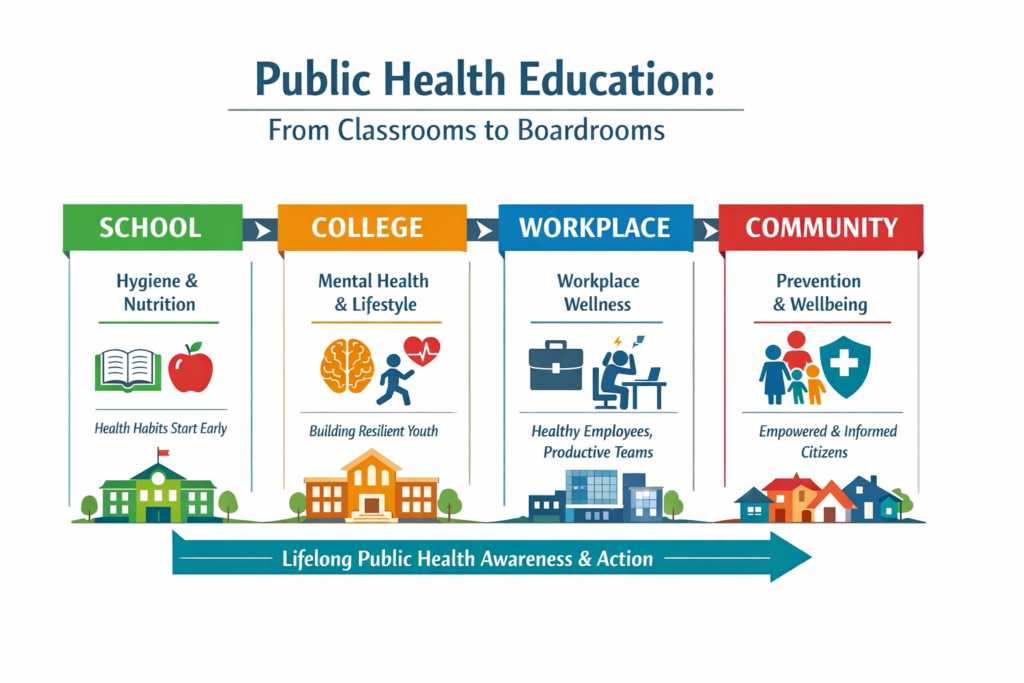
Public health is no longer just the responsibility of hospitals and doctors. It is a shared responsibility that begins in classrooms, continues in workplaces, and shapes entire communities.
Over the last decade, especially after the COVID-19 pandemic, it has become clear that health outcomes are determined more by behaviour, awareness, and systems than by treatment alone. Lifestyle diseases, mental-health concerns, infectious outbreaks, workplace burnout, and environmental risks have all exposed a critical gap: lack of structured public-health education.
Public Health: More Than Hospitals and Medicine
Public health focuses on prevention, protection, and promotion of health at the population level. It includes: (1) Environmental and digital health awareness (2) Hygiene and sanitation practices (3) Nutrition and lifestyle behaviours (4) Mental health and stress management (5) Workplace health and safety. Unlike curative medicine, public health works before disease occurs, reducing long-term costs, suffering, and system overload.
Why Schools and Colleges Must Start Early
Children and adolescents form habits that last a lifetime. Schools and colleges are therefore the most powerful platforms for public-health education. Effective public-health training for students helps: (1) Build hygiene and self-care habits (2) Improve mental resilience and emotional well-being (3) Reduce lifestyle-related risks early (4) Align with holistic education goals under NEP-2020. When health education is integrated into regular learning—not treated as a one-day talk—it creates health-conscious citizens, not just informed students.
Public Health in the Corporate World
Workplaces today face rising levels of: Stress and burnout, Lifestyle disorders (diabetes, hypertension, obesity), Absenteeism and reduced productivity. Corporate public-health training addresses: (1) Stress management and mental well-being (2) Ergonomics and occupational health (3) Preventive lifestyle practices (4) Creating a culture of wellness, not crisis management. Healthy employees are not just a social responsibility—they are a strategic asset.
Public Health for the General Public
Public health empowers individuals to make informed daily decisions: (1) Food choices (2) Physical activity (3) Sleep and screen habits (4) Preventive check-ups. Health literacy improves not only individual outcomes but also community resilience.
Why Structured Training Matters
One-time awareness programs rarely lead to behaviour change. Effective public-health education requires: (1) Age- and audience-specific modules (2) Interactive and practical learning (3) Repetition and reinforcement
Conclusion
From classrooms to boardrooms, public-health education is no longer optional—it is essential. Investing in structured public-health training today creates healthier individuals, stronger institutions, and resilient communities tomorrow.
good one